News
Reconstructing AI Power Systems Through Magnetic Design: LinkCom’s Matrix Inductor Technology Enhances Power Efficiency and Stability.
【May 25, 2026】As AI servers and High-Performance Computing (HPC) continue to advance rapidly, data centers are moving toward increasingly higher power density. Under this trend, power systems have evolved from a supporting role into a core factor that directly impacts overall system performance.
Particularly in next-generation AI architectures, computing chips often need to draw hundreds to thousands of amps of transient current within extremely short periods of time, creating unprecedented challenges for power design. Traditional discrete inductor architectures are no longer able to simultaneously meet the demands of fast transient response, low current ripple, and high miniaturization.
In previous generations of power architecture optimization, the industry primarily focused on:
• Control algorithms
• Power IC efficiency
• System architecture
However, under extreme high-frequency and high-current conditions, magnetic components themselves have become the final performance bottleneck.
As current requirements scale to AI-level workloads:
• Suppressing ripple requires larger inductors
• Larger inductors negatively affect transient response speed
• Heat accumulation further reduces overall system efficiency
This design trade-off has become one of the key contradictions in today’s AI power architectures.
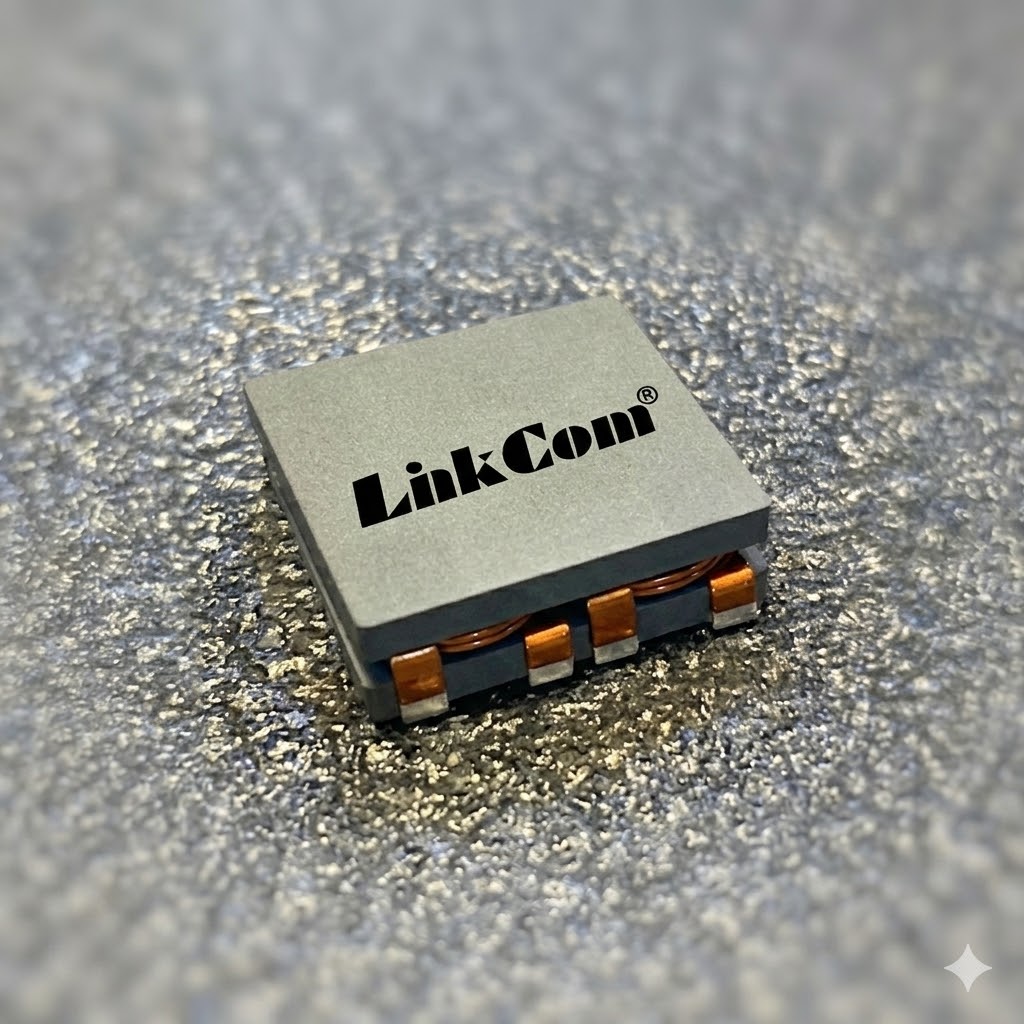
To address these challenges, LinkCom Manufacturing Co., Ltd. has leveraged its long-standing expertise in magnetic component design to introduce its Matrix Inductor technology, fundamentally reconstructing magnetic circuit architecture from the ground up.
At the core of this innovation is Magnetic Coupling design. By integrating multi-phase inductors into a single magnetic structure, magnetic flux from different phases can interact and partially cancel one another. This approach delivers three major benefits:
Significantly Reduced Current Ripple
Through magnetic flux cancellation, current fluctuations during steady-state operation are effectively minimized.
Enhanced Transient Response
Power delivery stability is maintained even during rapid load changes.
Optimized Core Loss and Efficiency
Reduced core loss improves overall power conversion efficiency.
Compared with conventional designs, the Matrix Inductor no longer forces trade-offs between “Ripple vs. Response vs. Size,” but instead improves all three simultaneously.
Notably, the Matrix Inductor is not a standardized component, but rather a highly design-intensive integrated technology.
Under high-frequency and high-current operating conditions, its development involves:
• Electromagnetic simulation and flux management
• Magnetic material selection
• Thermal and mechanical integration design
Through advanced electromagnetic and thermal simulation capabilities, LinkCom Manufacturing Co., Ltd. can customize the optimal magnetic circuit configuration for different AI chip architectures. This not only enhances performance, but also shortens system development cycles and establishes a stronger technological barrier to entry.
Within AI data centers, even minor energy losses can scale into significant power costs and thermal management challenges. Therefore, the significance of the Matrix Inductor extends beyond improving a single component — it represents a broader advancement for the entire industry.
As AI infrastructure continues to evolve, the competitive focus of power systems is gradually shifting from “control” toward “magnetic design.” LinkCom Manufacturing Co., Ltd. stated that it will continue deepening the integration of magnetic components and power architectures, positioning the Matrix Inductor not only as an innovative product, but also as a key technological foundation driving the next generation of AI power infrastructure.